Put it on the class screen
This Christmas object lesson takes kids inside a village house in Bethlehem, where Mary laid her newborn son in the animals' feeding trough. It uses a loaf of bread, a loaf pan and a few strips of cloth, takes about 12 minutes, and works on its own or as the hands-on part of your kids' Christmas Bible lessons in December.
Get ready
Put the loaf of bread where kids can't see it. Fill the loaf pan with shredded paper or oats. Cut or tear the towel into three or four long strips. Clear a table: for this lesson the tabletop is the family's living floor, and the floor beside it is where the animals sleep.
Teach it: the house of bread
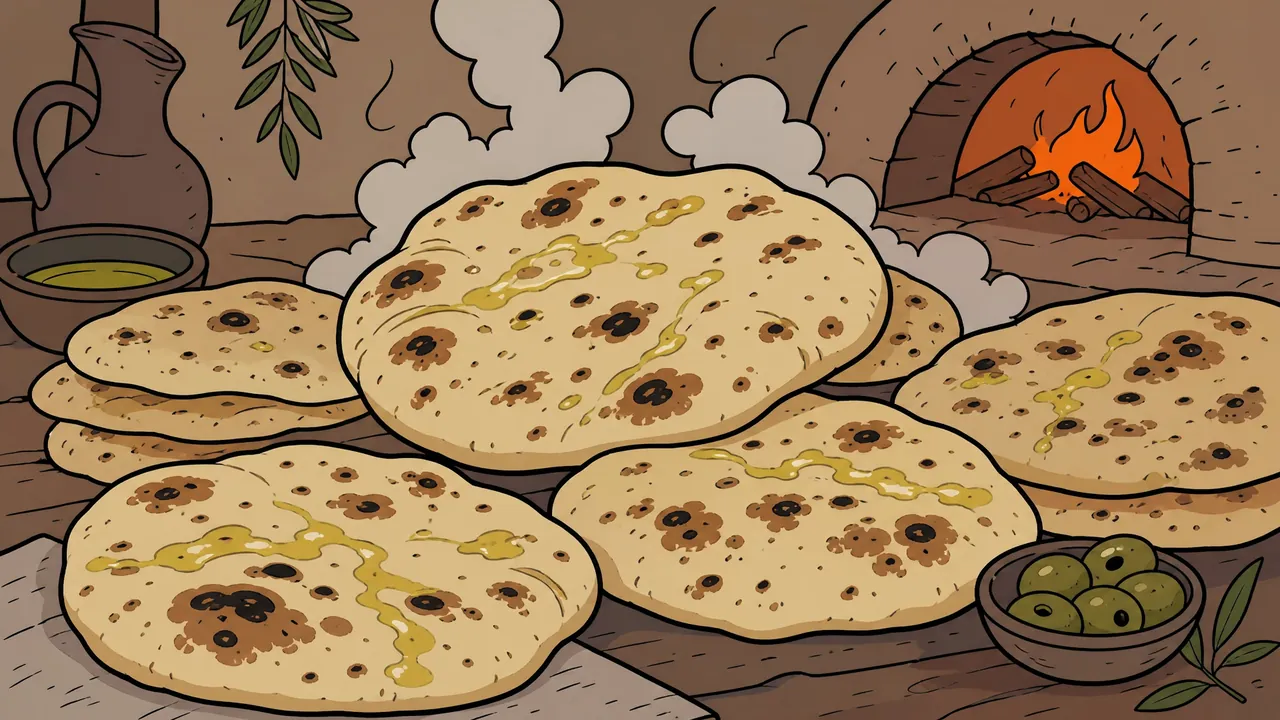
Bring out the bread and hold it up.
"Who likes bread? Fresh bread, warm bread, bread with butter? Today we're going to a town whose name means bread."
Read Micah 5:2:
"But you, Bethlehem Ephrathah, being small among the clans of Judah, out of you one will come out to me who is to be ruler in Israel."
"In Hebrew, the language of the Bible, Bethlehem is Beit Lechem. Beit means house. Lechem means bread. Bethlehem means house of bread. It was a little farm town, and hundreds of years before Jesus, God promised that a great ruler would be born there."
Set the bread aside. You'll need it again.
Teach it: the manger
Hold up the loaf pan full of hay.
"This is from Bethlehem too. What do you think it is?" (A bed? A box? A bread pan?)
"It's a manger. That's an old word for a feeding trough, where animals eat their dinner. Who eats out of a manger?" (Cows, donkeys, sheep.)
Read Luke 2:4-7. Joseph went to Bethlehem because he came from King David's family, and Mary went with him.
"She gave birth to her firstborn son. She wrapped him in bands of cloth and laid him in a feeding trough, because there was no room for them in the inn."
"God's own Son, the King, and his first bed was the animals' dinner dish."
Did you know?
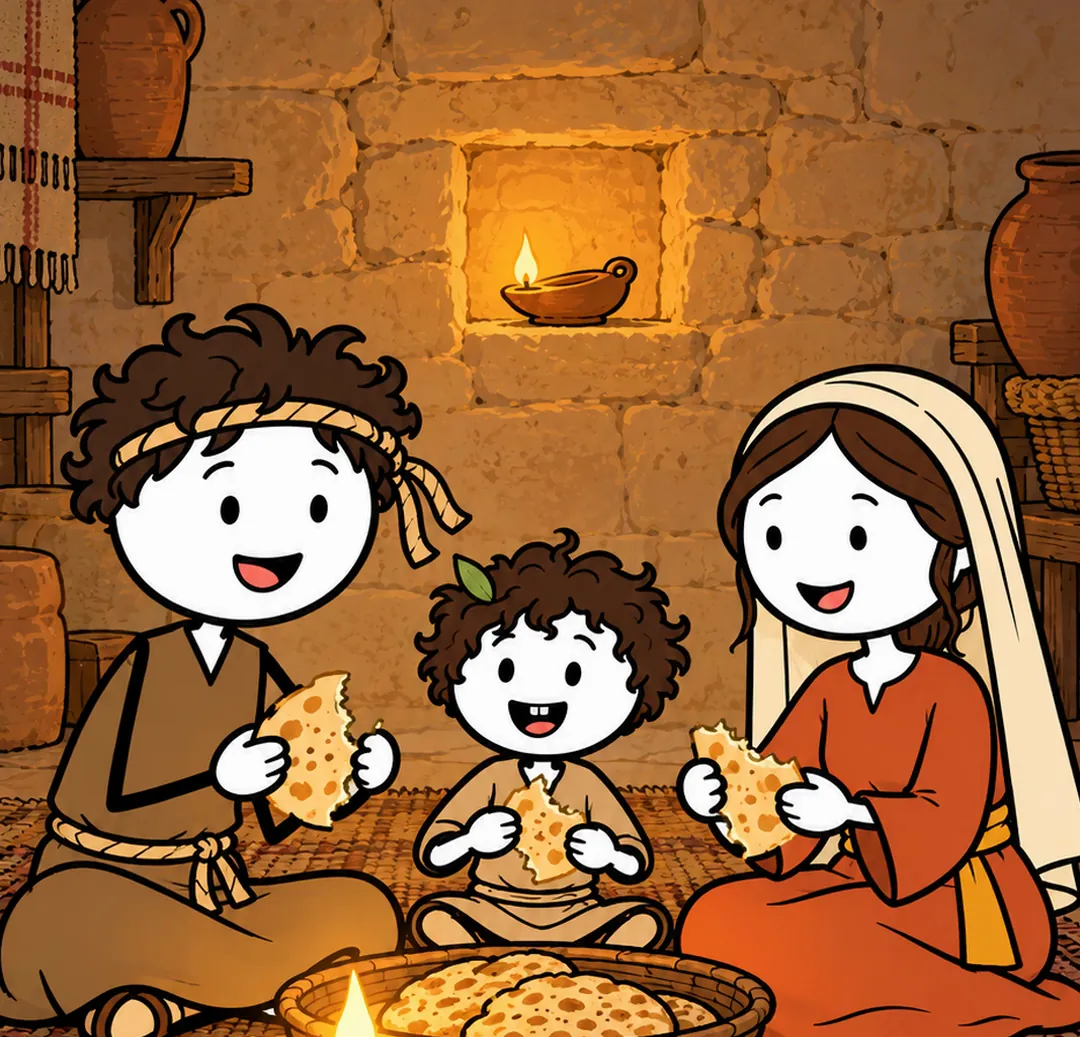
In Jesus's day, many village families lived in one big room. Most of the room was a raised floor where the family cooked, ate and slept. At one end, a step or two lower, was a space where the donkey, a cow or a few sheep were brought in at night, to keep them safe and to keep the house warm. The manger might be a stone trough or a hollow at the edge of the family's floor, so the animals could reach their hay. Archaeologists have found stone mangers built into much older Israelite houses, and Kenneth Bailey, a scholar who lived in the Middle East for decades, described village homes still built this way in modern times.
Show it with the table: the manger sits on the table's edge, and the "animals" sit on the floor below.
And the inn? The word Luke uses is kataluma. Later in his Gospel, Luke uses the same word for the guest room where Jesus ate the Last Supper (Luke 22:11). When Luke means a roadside inn, in the Good Samaritan story, he uses a different word (Luke 10:34). So many scholars think "no room" meant the guest room was already full, and Mary had her baby in the family's main room, beside the animals. Others aren't so sure. A very early Christian writer, Justin Martyr, wrote around AD 150 that the birth happened in a cave near the village. Either way, Luke tells us the part that matters: Jesus's first bed was a feeding trough.
Teach it: the swaddling cloths
Hand a child the baby doll and the cloth strips. Help them wrap the baby snugly, around and around.
"Mary wrapped Jesus in strips of cloth like this. Every mother in Bethlehem did the same for her baby. It wasn't fancy. It was just what you did for a newborn."
An old Jewish book called the Wisdom of Solomon has the great King Solomon saying he was wrapped in swaddling cloths too, because no king ever came into the world any other way.
Lay the wrapped baby in the manger. Read Luke 2:12, the angel's words to the shepherds:
"This is the sign to you: you will find a baby wrapped in strips of cloth, lying in a feeding trough."
"Shepherds were working people who smelled like sheep. A king in a palace might have scared them away. But a baby in a feeding trough, the kind of bed any poor family might use? They could walk right in. Jesus came to ordinary people first."
The big turn: bread in the manger
Put the loaf of bread next to the manger.
"Let's put it all together. A baby was born in the house of bread. His mother laid him in a feeding trough, the place where hungry animals came to eat."
Read John 6:35, from when Jesus was grown up:
"I am the bread of life. He who comes to me will not be hungry, and he who believes in me will never be thirsty."
"Bread keeps your body alive for a day. Jesus came to give us life with God that lasts forever. Christmas is when God's Son came to be with us, as a real baby, in a real house, ready to feed the whole world."
Talk about it
- What was the strangest thing about where Jesus slept on his first night?
- Why do you think God chose a plain village house instead of a palace?
- The shepherds hurried to see Jesus. Who could you tell about him this Christmas?
- Bread is something you need every day. How is Jesus like that?
Pray together
Break the bread (or open the crackers) and pass it around. Before anyone eats, pray:
"God, thank you for sending Jesus as a real baby to a real family. Thank you that he came for ordinary people like the shepherds, and like us. Jesus, you are the bread of life. Help us come to you every day. Amen."
Take it further
- Preschool: Act it out. Kids sit on the floor as the sheep and donkeys while one child "wraps" the baby and lays it in the manger. Then everyone tiptoes up the "steps" to see.
- Elementary: Pair this with the Christmas Bible word search. Ask kids to find the words that came from this lesson: manger, Bethlehem, shepherds, baby.
- Preteen: Read John 6:30-35 and the Bread of Life object lesson. The crowd wanted bread from heaven like the manna. Ask: why would Jesus call himself bread instead of something grander?
Sources
- Kenneth E. Bailey, "The Manger and the Inn: A Middle Eastern View of the Birth Story of Jesus", Presbyterian Outlook (2006)
- Stephen C. Carlson, "The Accommodations of Joseph and Mary in Bethlehem: Κατάλυμα in Luke 2.7", New Testament Studies 56 (2010)
- Ian Paul, "Once more: Jesus was not born in a stable", Psephizo
- "Iron Age Pillared House", Biblical Archaeology Society
- Sandra L. Richter, "Christmas decorations, anyone?", from The Epic of Eden
- Justin Martyr, Dialogue with Trypho, chapter 78 (around AD 150)
- Wisdom of Solomon 7:4-5
Questions teachers ask
What is a good Christmas object lesson for kids?
A manger works well, because kids can hold it. Use a loaf pan as the feeding trough, wrap a doll in strips of cloth the way Mary wrapped Jesus (Luke 2:7), then hold up a loaf of bread. Bethlehem means "house of bread" in Hebrew, and the baby laid in an animals' feeding trough grew up to say, "I am the bread of life" (John 6:35).
Was Jesus born in a stable?
The Bible never says "stable." Luke 2:7 says Mary laid Jesus in a manger, a feeding trough, "because there was no room for them in the inn." Luke's word for inn is the one he later uses for the guest room of a house (Luke 22:11), so many scholars think Jesus was born in a family's main room, where animals were brought in at night. Others disagree, and an early tradition from Justin Martyr (around AD 150) places the birth in a cave near the village. All agree on the feeding trough.
What were swaddling cloths?
Long strips of cloth wrapped snugly around a newborn. It was ordinary care for a baby in Bible times. Ezekiel 16:4 lists washing, rubbing with salt and wrapping in cloths as what a family did for a newborn, and an old Jewish book, the Wisdom of Solomon, pictures even King Solomon being swaddled, because every king starts life the same way.
Why was Jesus born in Bethlehem?
Luke 2:1-5 says Caesar Augustus ordered a registration, and Joseph went to Bethlehem because he was from the family of King David, who grew up there. About 700 years earlier, the prophet Micah had said a ruler of Israel would come from little Bethlehem (Micah 5:2), and Matthew 2:5-6 quotes that promise.
How do I teach the Christmas story to preschoolers?
Let them handle it. One child puts the hay in the manger, another wraps the baby, and the rest sit on the floor as the sheep and donkey in the animal end of the house. Keep the words short ("Jesus came as a real baby") and finish by sharing bread.
Topics: Jesus, God's Love