
What Did People Eat? · 14:03
What Did People Actually Eat in Jesus's Time?
Follow one ordinary day of food in first-century Galilee, from grinding stones to a boat found in the mud, and see what it adds to the Gospel food stories.
Teach this on Sunday ↓In this episode




Free teaching kit
Teach this on Sunday
Play the video, then pick what fits your time. Everything here is free.
1Talk about it
- What surprised you most about what people ate in Jesus's day?
- The boy's five loaves were barley, the cheap bread. Why do you think John mentions that?
- Bread was most of what people ate. Why might Jesus have called himself "the bread of life"?
- What's one food you eat that nobody in Galilee would have recognized?

3Color it
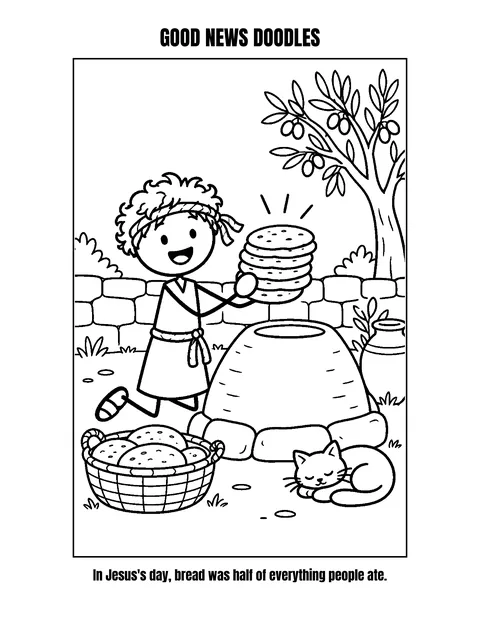
Bread Day Coloring Page
Download the PDFWant the background? Read “What Did Jesus Eat? Food in Jesus's Day”
Read the transcript
Bread, and more bread
It's seven in the morning. You open the fridge. Cereal, milk, coffee. Breakfast takes four minutes, and you eat it standing up.
Now rewind two thousand years.
You wake up on a mat in a stone house in Galilee. There is no fridge. There is no breakfast. There is, however, a long morning of work. Your stomach has opinions about this.
Much later, the rabbis of the Talmud described a custom: most people ate their first meal around the fourth hour of the day. That's about ten in the morning.
And the rabbis warned against waiting until noon with nothing in you. Eating then, they said, was like throwing a rock into a pouch. Your stomach is the pouch.
So what's in that first meal? Your brain is already telling you: lamb, grapes, a feast. A table straight out of a painting.
The answer was buried in the ground the whole time. Grinding stones. Ovens. And some very old rules about who gets how much. Let's dig.
Start with the plainest claim. Bread wasn't part of the meal. Bread was the meal.
How much bread? Scholars still argue about the exact share. One estimate puts it at about half of all calories. A summary of food historian Susan Weingarten says fifty to seventy-five percent of the whole diet.
Either way, if you're hungry in Galilee, the question isn't what's for lunch. It's how much bread is left, and who's going to make more.
Bread starts as grain, and grain has to be ground. Every single loaf. At Shikhin, a village near Sepphoris, excavators found basalt querns and mortars.
Basalt is the dark local stone around the Sea of Galilee. So the stones at Shikhin also point to trade with lakeside villages.
Who did the grinding? Women ground the flour and baked the household bread themselves.
By this period, the old saddle quern, a flat stone worked on hands and knees, was mostly left to small villages. You live in a small village. Your mother's knees know it.
Then the oven. It's called a tannur: a beehive-shaped clay oven about a meter high, open at the top and bottom. A fire burns on the floor inside.
The baker slaps flat rounds of dough onto the hot inner wall. No pan. No tray. Just hot clay. A few minutes later, they peel off, blistered and golden.
The fuel is kindling and animal dung. You collected the dung. You'd rather not discuss it.
So how much bread did a person actually need? There's a surprisingly exact answer. The Mishnah, written down around 200 CE, sets a minimum weekly food allowance a husband owed a separated wife.
Two qabs of wheat a week. Or four of barley. Plus some beans and lentils, a little oil, and dried figs. That's the minimum. The floor, not the feast.
Twice as much barley, because barley was the cheaper grain. Malina and Rohrbaugh calculate the whole ration at about eighteen hundred calories a day. Weingarten says that would barely suffice.
Which brings us to a story you may know. In John's Gospel, at the feeding of the five thousand, the text says: 'There is a boy here who has five barley loaves and two fish.'
That one word matters. Barley was the cheaper grain, the one the Mishnah rations at double. Not the finer wheat. An everyday loaf, in a boy's hands.
And grain was right there in the fields. Mark tells how the disciples, walking through grainfields on the sabbath, began to pluck heads of grain.
Last question: what did bread cost? In Matthew's parable, vineyard workers are hired for a denarius a day. But scholars note wages varied, and the denarius wasn't a fixed standard wage.
The Mishnah's welfare rules give a hint. A wandering poor person had to be given at least a loaf worth a pundion, when wheat sold at a set price. Later rules, with conditions attached.
Stay over Shabbat, and you get enough for three meals. But if you already have money for two meals, the charity dish is not for you.
So that's your morning in Galilee. Grind, bake, wait until the fourth hour. Bread was the meal. And even the meal was measured.
What went in the bowl
So if bread was the meal, what was everything else? Something to scoop. In Galilee, bread was the spoon.
Here's what went in the bowl. Lentils. Beans. Peas. Chickpeas. Cabbage. Turnips. Eggs. That's the everyday list, from Jerome Neyrey and the Biblical Archaeology Society.
For flavour: dill, cumin, mustard. Salt seasoned the food, and preserved meat and fish. Pepper and ginger? Imported. Expensive. Not for you.
To sweeten anything, there was honey. And figs. Your sweet tooth gets two options. Both are excellent.
Now the stew pot. Chemical analysis of about two hundred fifty pots, from twenty-two sites, points to one village. Kefar Hananya.
From the late first century BCE, it supplied most of Galilee's kitchen pottery. And the rabbis praised its pots: they didn't crack in the fire.
Pots of its types even turned up with the Galilee boat. Your stew pot has a famous cousin.
Then the table. At Reina, in Lower Galilee, archaeologists found a cave workshop. Thousands of chalkstone cores. Pieces of stone mugs and bowls.
Why stone? Under Jewish ritual law, stone wasn't thought to become impure. Pottery could. Mark notes that many Jews would not eat unless they thoroughly washed their hands.
And the bowl was shared. In Mark's account of the Last Supper, Jesus speaks of 'one who is dipping bread into the bowl with me.' One bowl in the middle. Bread in the hand, used to scoop.
Now the odd item on the list. Locusts. The Mishnah, compiled around 200 CE, gives a checklist. Four legs. Four wings. Two jumping legs. And wings that cover most of the body.
Rabbi Yose adds one more test: it has to be called a hagav. You count the legs. Twice. Mark says John the Baptist ate locusts and wild honey.
The last piece of evidence comes from the other end of the process. Near Qumran, soil from a suspected latrine held eggs. Roundworm. Tapeworm. Whipworm. Pinworm.
But this one is disputed. The eggs can't be dated. They could have been left by later Bedouin. And Qumran was a desert sect's site, not a typical village. Still: whatever went in the bowl had to come out somewhere.
Oil, figs and a palm named Methuselah
So bread filled you up. But what made a meal feel rich? Oil and fruit. The luxury you could actually afford. Even the Mishnah's minimum ration included a little oil, and dried figs.
Oil first. And here's the surprise: Galilee came late to it. David Eitam's survey found only fourteen oil presses in Galilee from the tenth to the eighth centuries BCE. Samaria and Judea had hundreds.
Then came what Eitam calls a revolution. In the Hellenistic period, the lever-and-weights press. Its weights came in around fifteen hundred kilos. You are not lifting those.
Around the first century CE, a new machine arrived: the screw press. It multiplied what one press could produce. Though Eitam admits the date 'must still be studied.' And in Upper Galilee, they stuck with the lever.
At Gamla, a town destroyed in 67 CE, one olive press had a ritual immersion bath attached. Popular guides say excavators read it as concern for purity, even in the oil.
Oil didn't just go in the bowl. It lit the house. At Shikhin, near Sepphoris, excavators found seven molds for oil lamps. The most ever recovered from a village in Israel. Late first and second centuries CE.
Now fruit. Figs and grapes were everyday. Pomegranates, dates and almonds came less often. And fruit was dried, to get through the winter.
And date honey? Not from bees. It was a syrup made from dates. No bees were consulted.
Josephus raved about the plain of Gennesaret, beside the lake. Walnuts, palms, figs and olives, side by side. Grapes and figs ten months a year. A nineteenth-century cyclopedia called this 'glowing though exaggerated.'
He called the Jericho area the most fruitful part of Judea, full of palms. Mark Antony even handed Jericho's palms to Cleopatra. Herod later leased them back. Even the date trees had politics.
Which brings us to Masada. The Sicarii burned their central warehouse, and the walls collapsed inward. Underneath: salt, grain, oil, wine, pomegranates and dates.
Scraps of fruit still clung to some seeds. That Judaean date variety had long since vanished. About four decades after the dates were catalogued, someone planted one.
Today it stands about ten feet tall. A palm named Methuselah. A date from a burned storeroom, still growing.
The lake that fed Galilee
After bread, Galilee's pantry was a lake. Start with the water.
Josephus says it was good to drink. Left out on a summer night, it turned as cold as snow.
Its fish, he says, looked and tasted unlike fish anywhere else. One nearby spring produced the coracin fish. Some thought it was a branch of the Nile.
Then the night shift. Mendel Nun, a lake fisherman for over fifty years, describes the trammel net. Three layers, linen in Jesus' day.
Two walls of big mesh, a loose one between. Corks on top, lead weights below.
You set it at night, in a wide curve. Gourds mark the ends in the dark. Your own hands are invisible. The gourds are not.
There was also the big seine, or dragnet. Nun calls it the oldest net, and once the main method here.
Now hard evidence. In 1986, during a drought, fishermen found a hull in the mud near Ginosar. Eight point two metres by two point three.
Radiocarbon: roughly 120 BCE to 40 CE. Nothing ties it to any person. Just a fishing boat.
Next, Magdala. Its Greek name, Taricheae, refers to salting fish. The rabbis called it Migdal Nunia. Fish tower.
Strabo, writing shortly before Jesus was born: 'At the place called Tarichaea, the lake supplies the best fish for curing.'
Digs found a market with twenty-eight shops. About three hundred fishing weights. Over four thousand coins. And pools, probably for salting fish. Probably. That's an interpretation.
Magdala also pickled the Kinneret sardine, a tiny lake fish. A big export? Mendel Nun argued yes. Magen Broshi argued no. The sardine has no comment.
Fish travelled. Jerusalem's first-century garbage held 590 fish bones, mostly Mediterranean, some from Galilee. Fresh fish spoils. Omri Lernau thinks they were probably sold dried, salted or smoked.
Kosher limits held. In about twenty-one thousand bones, scaleless catfish, sharks and rays, once common in Jerusalem, fall under three percent. Clear avoidance shows from the first century BCE.
When those rules began is still argued. But your fish almost always had scales.
Even garum, the Roman fish sauce, may have had a pure version. Pompeii jars say garum castum. Pliny mentions one for Jewish rites. Scholars disagree.
Back at the lake, John's Gospel tells of a night of fishing that caught nothing.
The disciples come ashore, and see a charcoal fire there, with fish on it, and bread.
Fish from the lake. Bread from the field. Breakfast.
Meat, wine and the rare feast
Last question. When did you eat meat? Almost never. Jerome Neyrey puts it plainly: meat and poultry were expensive. Most people ate them only at feasts and holidays.
And the trash proves it. Jerusalem's city dump, from about 37 BCE to 66 CE. Cooking pots, the most common pottery. Broken clay ovens. Kosher animal bones.
And no pig bones. Other Roman cities of the time ate pork. Jerusalem's garbage didn't. Why so many cooking pots? The authors suggest pilgrims. Another study points to the Temple sacrifice trade. Scholars still argue.
A Tel Aviv University study looked at over five thousand bones from a first-century Jerusalem dump. Mostly sheep and goats. Very little cattle or chicken. No pigs.
And not prime cuts. Lidar Sapir-Hen reports that ordinary households ate older animals. Tougher meat. Pigeon bones turned up only near the Temple Mount, in a ritual setting. You chew. You keep chewing.
Now a house burned in 70 CE. The Burnt House. Seventy-seven percent of the identified bones were sheep or goat, mostly young animals. No pigs. And only three fish bones. All grey mullet, a kosher fish.
Back in Galilee, Capernaum shows the same pattern. No pig bones. No non-kosher fish. Nearby Bethsaida and the Decapolis cities are different.
That's the world behind a parable in Luke. The prodigal son ends up far from home, among pigs. In this world, the pigs alone tell you how far.
Luke says he would gladly have filled himself with the pods that the pigs were eating. The pods are usually identified as carob.
Then he comes home. And his father says: get the fatted calf and kill it, and let us eat and celebrate. Meat. For a feast. Not a Tuesday.
Then wine. The Mishnah's minimum allowance left it out. The Tosefta explains why: a woman has no claim for wine, for the wives of the poor do not drink wine.
Wine was sometimes mixed into water. One summary says that made the water safer. That's an interpretation.
Still, people made it. Nazareth Village found a wine press cut into the bedrock, five hundred metres from the original village. Small presses like it were common in the Hellenistic and Early Roman periods.
And there was one day ordinary families poured wine: a wedding. John's Gospel tells of a wedding at Cana. And at Cana, John says, the wine gave out.
You open the fridge. They opened a jar of dried figs. You eat meat on a Tuesday. They ate it at a wedding.
You toss leftovers. They left almost nothing, and archaeologists are still sifting it.
Tomorrow, at the fourth hour, there will be a barley loaf. And it will be enough.
Sources (46)
- What Did People Eat and Drink in Roman Palestine? (Biblical Archaeology Society)
- Kefar Shikhin chapter (Shikhin Excavation Project PDF)
- Jerome Neyrey, Reader's Guide to Meals, Food and Table Fellowship (Univ. of Notre Dame)
- "Holy Garbage": A Quantitative Study of the City-Dump of Early Roman Jerusalem (abstract)
- Archeologists reveal what Jerusalemites ate 2,000 years ago (Ynetnews)
- Jerusalem Burnt House Fish remains 2010 (abstract)
- What Kinds of Fish Were Eaten in Ancient Jerusalem? (TheTorah.com, by Omri Lernau)
- Haaretz: Israeli archaeologists discover what ancient Judeans actually ate
- Simon Peter in Capernaum: An Archaeological Survey (BYU Religious Studies Center)
- The Fishy Secret to Ancient Magdala's Economic Growth (Biblical Archaeology Society)
- Sea of Galilee Boat (Wikipedia)
- Hastings' Dictionary: Gennesaret, Land of (quoting Josephus, Jewish War 3.10.8)
- The Garum Debate (Biblical Archaeology Society)
- Kefar Ḥananya (New Encyclopedia of Archaeological Excavations, BAS Library)
- Stone Vessel Workshop Discovered in Galilee (Archaeology magazine)
- Gamla (BibleWalks)
- Gennesaret According to Josephus (Jerusalem Perspective)
- Remote Latrine Re-confirms the Presence of Essene Sect at Qumran (Hebrew University, Orion Center)
- Josephus, Wars of the Jews Book 3, ch. 10
- Mishnah Peah 8:7 (Sefaria)
- Compare Didache 11:6 and Mishnah Peah 8:7 (intertextual.bible)
- A Date Palm Named Methuselah (Science Friday, excerpt from The Triumph of Seeds)
- Olive Culture in Ancient Israel, David Eitam (Gems in Israel)
- Wine Press (Nazareth Village)
- Pesachim 12 (My Jewish Learning, Talmud page)
- Pesachim 12b halachic summary (Dafyomi Advancement Forum)
- Biblical Bread: Baking Like the Ancient Israelites, Cynthia Shafer-Elliott (Biblical Archaeology Society)
- History: The Best Salted Fish (Magdala project)
- Pickled Sardine Exports (Jerusalem Perspective)
- 'Let Down Your Nets', Mendel Nun (Jerusalem Perspective)
- What were the eating habits of 1st-century Jerusalemites? (Hayadan, on the Tel Aviv University study)
- Kosher locust (Wikipedia, citing Mishnah Hullin 3:7)
- Samford Excavation in Israel Reveals Ancient Jewish Lamp Workshop (Samford University, 2015)
- Josephus, The Wars of the Jews 1.138 (Lexundria)
- Josephus, The Wars of the Jews 1.361 (Lexundria)
- Food (Emory University, Ancient Artifact Activities)
- Was the Denarius a Daily Wage? (Interpreter Foundation)
- John 6:9 (NRSVUE, Bible Gateway)
- John 21:9-13 (NRSVUE, Bible Gateway)
- Mark 1:6 (NRSVUE, Bible Gateway)
- Luke 15:16 (NRSVUE, Bible Gateway)
- Luke 15:23 (NRSVUE, Bible Gateway)
- John 2:1-10 (NRSVUE, Bible Gateway)
- Mark 14:20 (NRSVUE, Bible Gateway)
- Mark 2:23 (NRSVUE, Bible Gateway)
- Mark 7:2-3 (NRSVUE, Bible Gateway)